




Posted by Jonny Rosch , Reid Peterson and Bradford Jones in Consulting, Healthcare, Cloud Accounting.
Key points covered in this article:
- Outsourcing can help healthcare organizations reduce costs, improve access to specialized expertise, and ease pressure on internal teams, but not every function is a strong fit. A thoughtful evaluation helps CFOs determine where outsourcing can create meaningful value without introducing unnecessary operational, compliance, or patient-care risk.
- The strongest candidates for outsourcing are often functions with high operating costs, persistent staffing challenges, limited strategic differentiation, and manageable risk. Areas such as accounts payable, payroll administration, IT help desk services, financial reporting support, and cybersecurity monitoring may offer earlier opportunities for consideration.
- Building the business case requires more than comparing vendor fees to salaries. Healthcare leaders need to assess total current costs, implementation demands, risk exposure, oversight responsibilities, and how success will be measured before making a transition.
Healthcare organizations are under more financial pressure than they have been in years. Rising labor costs have made it harder for providers to maintain traditional operating models, and changes in government funding and reimbursement are adding more uncertainty to the revenue side. Finance leaders are being asked to find efficiencies wherever they can.
Outsourcing is one option. Third-party providers can often deliver specialized services at a lower cost than maintaining the same function with an in-house team. Some estimates put the savings in the range of 30% to 40%, creating the value that justifies this type of organizational transition.
Not every function is a good fit, though, and some carry more risk than others. A step-by-step approach can help healthcare CFOs see where outsourcing is likely to make the biggest impact without introducing unnecessary risk. Here’s one way to work through it.
Step 1: What Can Be Outsourced?
The first step is understanding the options. Most fall into three categories.
Financial and administrative functions are among the most common. Accounting, accounts payable, payroll, human resources and benefits administration, recruiting, procurement, and revenue cycle management can all be handled in whole or in part by outside providers.
Technology is another area to consider. Help desk support, infrastructure and cloud management, cybersecurity, EHR and application support, data management and analytics, and health information management may all be candidates.
Some clinical functions can also be outsourced, including radiology interpretation, telehealth, temporary clinical staffing, and other specialized services.
An organization might outsource an entire function, move a specific process to an outside provider, or bring in additional resources to support an existing internal team. At this point, the goal is simply to understand what is possible. The next question is where changing the model could actually make a difference.
Step 2: Where Is the Greatest Opportunity?
The strongest outsourcing opportunities usually start with a problem that needs to be solved.
A function may simply cost too much to maintain internally. Another may have persistent vacancies or turnover. Performance may be falling short, or the organization may be struggling to recruit specialized talent. In other cases, back-office employees may be spending time on work an outside provider could perform more efficiently.
Understanding the true cost of the current model is important here. Salary is only part of it. Recruiting, overtime, turnover, training, technology, temporary staffing, and management time can make an internally managed function considerably more expensive than the department budget initially suggests.
In revenue cycle management (RCM), for example, high denial rates or growing days in accounts receivable can have a direct effect on cash flow. Or a healthcare organization may be looking to gain access to expertise in the areas of risk management or cybersecurity that it cannot easily recruit. The value outsourcing creates will depend on the problem it is expected to solve.
On the strategic end, a function closely tied to the organization’s competitive position or brand promise may warrant a different analysis, even when outsourcing could lower costs. The goal is not always to find where an outside provider could save some money. It is to find the places where the potential improvement is meaningful enough to justify a change.
Step 3: What Are the Risks?
Once the biggest opportunities are identified, CFOs can look at the other side of the equation. What are the risks? What level of risk is acceptable? Can it be managed?
The answers vary by function. An accounts payable problem can delay payments and frustrate vendors. An outage involving a critical technology system can interrupt operations. A problem with an outsourced clinical service could affect quality of care or patient safety. The consequences are different, and the analysis should reflect that.
Healthcare organizations also have regulatory and data concerns that follow the work outside the organization. Depending on the function, an outside provider may have access to protected health information, financial data, employee information, or other critical systems. Cybersecurity, HIPAA compliance, business continuity, and third-party access all become part of the decision.
Outsourcing can mean giving up some control or losing institutional knowledge. It can also affect parts of the patient experience, which touches on the organization’s brand identity and reputation.
Before making a decision, healthcare leaders can rank their options from lowest risk to highest risk. Understanding where each function sits on that continuum helps CFOs narrow the field and prioritize their efforts.
Step 4: Is the Organization Ready to Make the Transition?
Something can have a compelling financial case and an acceptable risk profile and still be difficult to outsource.
Some work is easier to separate from the rest of the organization. Other functions depend on systems, employees, or workflows spread across several departments. Understanding those connections before making a decision can prevent an attractive opportunity on paper from becoming a difficult implementation.
A qualified vendor or provider needs to be available. And they must be able to meet the organization’s requirements for healthcare experience, staffing, technology, security, service levels, and scale. Those requirements add cost and time to the transition.
There also needs to be someone on the inside responsible for the outsourced relationship. The organization is still responsible for oversight, and someone will likely still need to monitor performance and address any issues.
In other words, the opportunity with the greatest theoretical cost savings may not be the best place to start. A somewhat smaller opportunity may make more sense if the organization is ready to execute it.
As healthcare leaders narrow the field, higher-priority outsourcing candidates often share several characteristics:
- High Operating Cost
- Difficulty Recruiting and Retaining Staff
- Limited Strategic Differentiation
- Minimal Direct Patient Impact
- Manageable Compliance and Operational Risk
These characteristics can help determine which functions may warrant earlier consideration and which may require more caution. The following matrix offers a useful starting point.
Outsourcing Priority Matrix
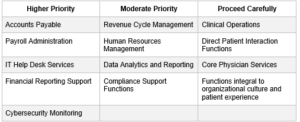
The matrix is a decision-making tool, not a fixed ranking. Each function should be evaluated based on the healthcare organization’s circumstances and business goals.
Step 5: Making the Business Case
The final step is turning the analysis into a business case that leadership can evaluate.
That starts with a clear picture of the current state. What does the function actually cost today? How is it performing? What staffing or operational problems exist? What technology and management resources are required to support it?
The proposed model can then be evaluated against that baseline. The analysis should include the vendor’s cost as well as implementation expenses, expected savings, performance improvements, transition timing, and the internal resources that will still be needed. Key risks should be identified along with how they will be managed.
Then, how will success be measured? If outsourcing is expected to reduce days in accounts receivable or improve compliance and reporting, those expectations should be documented before looking for an outsourced partner.
The business case for outsourcing looks to ROI, but it also looks to other hard-to-measure areas, like access to high-level talent and strategic fit. All of these may influence the recommendation.
Ultimately, leadership needs to determine whether outsourcing a particular function creates enough value to justify the cost and potential risk of making the change. In many cases, the answer is yes, especially when margins are tight and the current operating model is becoming more expensive to maintain.
Looking Ahead
There isn’t a universal answer to which healthcare functions should be outsourced first. With potentially significant cost savings available, however, outsourcing is worth evaluating as healthcare organizations look for ways to protect margins. For more information, contact the PBMares’ Healthcare team, led by Partner Jonny Rosch, Senior Manager Reid Peterson, and Outsourced Accounting Partner Brad Jones.
Be sure to consult with your financial or tax advisor on this topic as individual situations may vary. The information contained in this article or webinar, and any related materials, are for informational purposes only, and cannot be relied upon for legal, financial, tax, accounting, or other professional services advice. The content is provided on an “as is” basis and PBMares makes no representations or warranties about the accuracy or sustainability of any information for your purposes. For any specific questions you may have, please contact us.
This content is accurate at the time of publication. Always ensure you are reviewing the most recent information available. Contact your tax or financial advisor if you need clarification.
Contact Us
About the Authors

Bradford Jones
CPA, CVA, CMA, CFF
Partner, Outsourced Accounting Team Leader
Fredericksburg
Brad provides accounting and consulting services for privately held businesses and their owners to ensure compliance, meet regulatory and financial reporting requirements.
View Bio
Jonny Rosch
CPA
Partner, Healthcare Team Leader
Fairfax
Jonny brings a depth of expertise performing audit and assurance engagements and assisting not-for-profits with complicated accounting and tax issues unique to their industry.
View Bio
Reid Peterson
CPA
Senior Manager
Norfolk
Reid provides specialized assurance and consulting services to the firm’s healthcare, not-for-profit, and commercial clients.
View Bio