



Posted by Antonina McAvoy and Robert Parker III in Cybersecurity, Hospitality, Consulting, Risk Advisory, Business Risk.
Key topics covered in this article:
-
- Risk at private clubs changes throughout the year, not just during audit season. Staffing transitions, new systems, vendor changes, and operational shifts can introduce control, cybersecurity, and business continuity concerns that leadership needs to identify and address as they happen.
- A practical year-round approach to risk oversight can be built into existing board, finance committee, and management meetings. Regular discussions should focus on what has changed, what needs attention, and who is responsible, with attention to financial controls, cybersecurity safeguards, vendor oversight, incident preparedness, and corrective action tracking.
- Strong governance depends on follow-through. Clubs need processes to assign ownership, set deadlines, monitor unresolved issues, and make it easy for employees or members to report concerns. This helps leadership move from identifying risks to actually reducing them before they disrupt finances, operations, or member trust.
Risk Doesn’t Follow an Audit Calendar
Your club’s annual audit is complete. The board has reviewed the financial statements, and management is focused on the season ahead.
Three months later, a longtime controller retires, a new membership platform goes live, and a vendor requests updated banking instructions.
Each change introduces questions about financial controls, technology, member information, and daily operations. But how many of those questions make it onto the board’s agenda before something goes wrong?
Private clubs manage a unique combination of financial transactions, member relationships, hospitality operations, and technology systems. From seasonal staffing and member billing to golf tournaments, dining services and capital improvements, changes across the organization can introduce risks that aren’t immediately apparent.
The challenge isn’t simply identifying risks during audit season. It’s making sure leadership recognizes and addresses them as the business changes.
Building that awareness doesn’t require creating a separate risk management department. It requires governance processes that help leadership identify changes, evaluate risks, and follow through on decisions.
Give Risk Oversight a Place on the Calendar
For many clubs, the board, finance committee, and management team can incorporate risk oversight into existing meetings and reporting processes. A quarterly structure can help private club boards and management teams keep risk oversight on the agenda and support more informed business decisions.
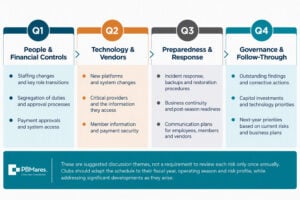
Each discussion should help leadership answer three questions:
What’s changed? What needs attention? Who is responsible for the next step?
The objective isn’t to generate more reports. It’s to give leadership timely information that supports decisions about staffing, technology investments, member services and operational priorities.
To make this approach part of everyday work, focus on these five habits.
1. Make Risk a Regular Leadership Conversation
Cybersecurity and fraud shouldn’t appear on the board agenda only after an incident or during the annual audit.
A quarterly discussion can help leadership understand what’s changed, which concerns need attention and whether previously identified issues have been addressed.
Management might report on significant staffing or technology changes, new service providers, suspicious transactions, cybersecurity incidents, and unresolved control deficiencies.
These conversations don’t need to become lengthy technical presentations. Leadership needs enough information to understand the business implications, challenge assumptions, and make informed decisions.
Picture a club getting ready to transition to a new membership management system. The discussion should go beyond functionality and cost. Who will have access to member information? How will financial data transfer into the accounting system? What happens if the provider experiences an outage during a major tournament or holiday event?
Cybersecurity risk requires continued attention, a principle reflected in the NIST Cybersecurity Framework 2.0. That includes the six functions, which are: Govern, Identify, Protect, Detect, Respond, and Recover. While the framework focuses on cybersecurity, its emphasis on governance, accountability, and continuous improvement offers a useful model for leadership oversight.
Question for club leadership: Are we discussing emerging risks regularly, or primarily reacting when something goes wrong?
2. Revisit Financial Controls and Cybersecurity Safeguards as Things Change
As your club evolves, so do the risks. Controls that worked well previously may not be sufficient today. Changes in staffing, technology, leadership, and payment processes can affect how transactions are approved; information is protected, and unusual activity is identified.
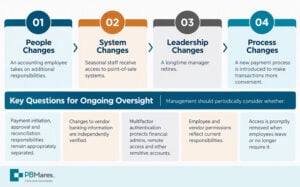
Where staffing limitations make separation of duties difficult, additional management reviews or other appropriate controls may help address the risk.
Evolving cyber risks make it important to regularly revisit existing safeguards. Findings from Verizon’s 2025 Data Breach Investigations Report underscore that concern: ransomware appeared in 44% of breaches examined, and the use of vulnerability exploitation for initial access rose 34% year over year.
Although these findings aren’t specific to private clubs, they illustrate why organizations should reassess security practices as threats evolve.
The Cybersecurity and Infrastructure Security Agency’s Cybersecurity Performance Goals also identify foundational practices, including access management and multifactor authentication, that organizations can use to prioritize security improvements.
Periodic cybersecurity evaluations can help leadership determine whether existing safeguards remain appropriate. Depending on the club’s needs, this might include a cybersecurity risk assessment that evaluates governance, processes and controls, or a vulnerability assessment focused on identifying technical weaknesses in systems and networks. Both can provide valuable insight to help leadership prioritize improvements based on risk, cost, and operational impact.
Question for club leadership: Have changes in our people, systems or processes created control or security gaps that we haven’t revisited?
3. Treat Vendor Oversight as an Ongoing Responsibility
Private clubs depend on outside providers for membership management, payroll, payment processing, reservations, technology support, and other essential services.
These relationships can enhance efficiency and the member experience, while introducing additional risks for clubs to manage.
Consider a membership platform that stores personal information, processes payments and connects directly to the club’s accounting system. A security incident, processing error or extended outage at that provider could affect multiple areas of club operations.
Leadership should understand which providers support critical functions, what information they access, and how management evaluates the associated risks.
A practical vendor oversight process should address financial reporting, cybersecurity, operational resilience and third-party risk concerns, including:
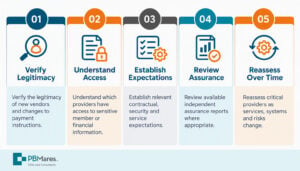
For example, SOC 1 reports may provide information about controls relevant to financial reporting, while SOC 2 reports may address applicable security, availability, and other trust services criteria. The usefulness of either report depends on its scope, reporting period, findings and relevance to the club’s use of the service.
The Federal Trade Commission’s vendor security guidance highlights the need to monitor vendor security practices, confirm compliance, and update protections as circumstances change.
Question for club leadership: Which outside providers could significantly disrupt our finances, member services or operations, and how do we know those risks are being managed?
4. Prepare for Disruptions Before They Happen
Imagine the club’s point-of-sale system stops working during a holiday weekend tournament or member event.
Dining operations are underway, members are checking in for events, and employees cannot process transactions normally.
Who decides whether to activate a backup process? How are transactions documented? Who takes the lead with the technology provider, keeps members informed and makes the call to return to normal operations?
These questions are easier to answer before an incident.
Incident response and business continuity planning should begin with identifying critical services, assigning responsibilities, and establishing practical response procedures.
For private clubs, this may include:
- Determining how essential financial and member services would continue during an outage.
- Maintaining backups and periodically testing restoration procedures.
- Establishing responsibilities for responding to suspected fraud or cybersecurity incidents.
- Identifying how management would communicate with employees, members, and service providers.
- Determining when insurers, legal counsel, technology specialists, or other advisors should be involved.
Reviewing plans is key as systems, employees, and service providers change. Periodic exercises can help avoid disruption and locate weaknesses.
The FTC’s cybersecurity resources provide guidance on incident response, disaster recovery and business continuity planning.
The objective isn’t to anticipate every possible incident. It’s to help employees and leadership make coordinated decisions when normal operations are disrupted.
Question for club leadership: If a critical system or provider became unavailable tomorrow, would our team know what to do?
5. Turn Findings and Concerns Into Measurable Action
Identifying a concern is only the beginning.
Perhaps the club’s CPA previously communicated a financial reporting control deficiency. Management identified unnecessary employee access to a membership system. A finance committee member questioned inconsistent vendor approval procedures.
Without clear ownership and follow-up, these issues can remain unresolved long after the initial discussion. Leadership should be able to understand not only what issues have been identified, but whether management’s corrective actions have reduced the underlying risk.
A practical corrective-action process should identify the concern, explain why it matters, assign responsibility, establish a reasonable completion date, and document how management will determine whether the corrective action is working.
Leadership should also make it easy for employees and members to report suspected fraud or other concerns. The Association of Certified Fraud Examiners 2024 Report to the Nations found that 43% of cases of occupational fraud examined were initially detected through tips, making tips the most common detection method.
Clubs should consider establishing a confidential reporting mechanism, such as a dedicated email address, hotline, or other channel with appropriate oversight by an audit committee or designated board representative.
Reporting procedures should address confidentiality, escalation, follow-up, and concerns involving senior management. Employees should understand how to raise concerns without concern of experiencing retaliation.
Not every issue requires an extensive project or outside assessment. Some may be addressed through clearer procedures, employee training, or additional management review. Others may warrant a more focused evaluation to understand the underlying risk.
Question for club leadership: When a concern is identified, can we demonstrate who owns it, what has been done and whether the underlying risk has been addressed?
A Practical Starting Point for Club Leadership
If you’re unsure where to begin, start with the Private Club Risk Readiness Checklist. Developed by PBMares, this complimentary resource includes 15 questions covering payment fraud, financial controls, member information, technology access, incident preparedness and governance oversight.
It also includes a worksheet to help leadership identify unanswered questions, assign responsibility and establish follow-up priorities. Use the checklist to prepare for your next board or management discussion, then revisit the results as your club’s people, systems and operations change. The checklist is a discussion aid, not a cybersecurity assessment, fraud examination or substitute for a financial statement audit.

The checklist is a discussion aid, not a cybersecurity assessment, fraud examination, or substitute for a financial statement audit.
Stronger Oversight Supports Stronger Business Decisions
The goal isn’t simply to prevent an incident. It’s to protect the trust members place in their club while giving leadership better information to make decisions that support its long-term success.
A year-round approach to risk oversight helps clubs recognize changes earlier, address concerns before they grow and make more informed decisions about staffing, technology investments, member services and operations.
PBMares works with private clubs and hospitality organizations across financial statement assurance, cybersecurity, fraud, IT risk and internal controls. When concerns warrant additional attention, our team can help evaluate specific risks through targeted cybersecurity assessments, vulnerability evaluations, fraud risk assessments, internal control reviews and internal audit services.
Is your club managing risk throughout the year, or mainly when audit season arrives?
Start by downloading the Private Club Risk Readiness Checklist to identify potential gaps, surface overlooked concerns and guide more productive conversations among club leadership, management and your CPA. Bring the results to your next leadership discussion and connect with Antonina McAvoy, Partner, Cyber & Risk Advisory, or Robert Parker, Partner and Hospitality Team Member, to explore whether any concerns warrant a more focused evaluation.
Be sure to consult with your financial or tax advisor on this topic as individual situations may vary. The information contained in this article or webinar, and any related materials, are for informational purposes only, and cannot be relied upon for legal, financial, tax, accounting, or other professional services advice. The content is provided on an “as is” basis and PBMares makes no representations or warranties about the accuracy or sustainability of any information for your purposes. For any specific questions you may have, please contact us.
This content is accurate at the time of publication. Always ensure you are reviewing the most recent information available. Contact your tax or financial advisor if you need clarification.
Contact Us
About the Authors

Antonina McAvoy
CISA, CISM, QSA, PCIP
Partner, Cyber & Risk Advisory
Norfolk
Antonina McAvoy specializes in cybersecurity, data protection, and privacy. She has 14 years of experience leading and performing a wide spectrum of cybersecurity reviews.
View Bio
Robert Parker III
CPA
Partner
Wilmington
Robert provides financial and compliance audit services to a variety of private and public sector clients, including those in industrial and commercial manufacturing, professional services, not-for-profits, private clubs, and employee benefit plans.
View Bio