
- People
- Insights
-
Industries
What are your needs?

When you’re looking for an advisory partner to help you simplify your industry’s unique complexities, PBMares has you covered.
-
Services
How can we help you?

Move forward with confidence and clarity, guided by a team of advisors dedicated to helping you reach your goals.
-
About
Get to Know PBMares

Innovation, agility, adaptability, and a drive to succeed are embedded in our culture. See yourself here.
-
Contact Us
Get in Touch

Have questions or need to get in touch with one of our offices? We’re here to help.
- Clients
- Payments
- Request for Proposal
- Search

Guide to Nonprofit Outsourced Accounting
Overview to Nonprofit Accounting
- Introduction to Nonprofit Accounting
- The Nonprofit Financial Challenge
- Outsourced Accounting for Nonprofits
- How Outsourced Accounting Supports Audit Preparation
- Choosing the Right Nonprofit Accounting Software
- Signs It’s Time to Consider Outsourcing
- Choosing the Right Outsourced Accounting Firm
- Contact Us
Introduction to Nonprofit Accounting
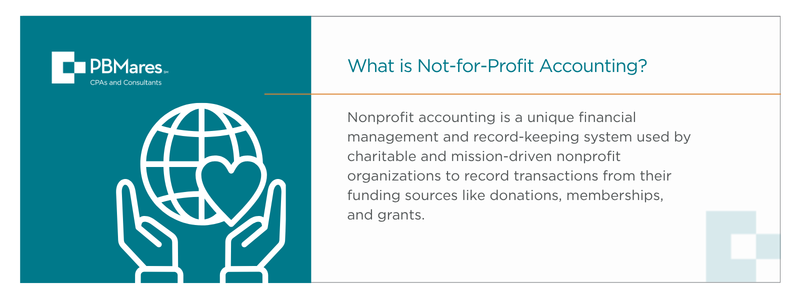
Nonprofit accounting is the process of recording, managing and reporting the financial activities of organizations that exist to advance a mission rather than generate profits for owners or shareholders. While nonprofit organizations use many of the same accounting principles as for-profit businesses, they face additional responsibilities related to donor restrictions, grant requirements, program spending and public accountability. An effective accounting system helps nonprofit leaders understand the organization’s financial position, manage limited resources and make informed decisions that support both immediate needs and long-term goals.
Accurate nonprofit accounting is essential to maintaining transparency and demonstrating that funds are being used responsibly. Donors, grant-making organizations, board members, regulators and community stakeholders expect nonprofits to provide clear information about how money is received and spent. Reliable financial records help organizations prepare accurate reports, comply with regulatory requirements and show that contributions are being directed toward their intended purposes. This level of accountability can strengthen donor confidence, improve relationships with funding sources and support the organization’s long-term financial sustainability.
Nonprofit accounting includes a broad range of responsibilities. Organizations must properly record contributions, distinguish between restricted and unrestricted funds and track grant-related revenue and expenses. They must also allocate costs among programs, management activities and fundraising efforts, prepare financial statements and budgets, maintain internal controls and meet federal, state and local tax-filing requirements. Depending on the organization’s size, funding sources and activities, it may also need to prepare for a financial statement audit, Single Audit or other regulatory examination.
Managing these responsibilities can be challenging, particularly for organizations with limited staff or rapidly changing funding needs. Many nonprofits use outsourced accounting services to gain access to professionals who understand nonprofit financial reporting, grant compliance, fund accounting and tax requirements. Outsourcing can provide stronger financial oversight and more timely reporting without requiring the organization to build a large internal accounting department. It can also allow nonprofit executives and program leaders to spend more time advancing the mission while experienced professionals manage the organization’s financial systems, reporting processes and compliance obligations.
The Nonprofit Financial Challenge
Nonprofit leaders face a constant tug-of-war between advancing their mission and managing complex back-office demands. Finance in the social sector carries unique pressures that general business accounting does not prepare executive directors for, leaving leadership trapped between lean budgets and strict regulatory oversight.
Strain of Full-Time In-House Staffing
Building an internal accounting department requires capital that many tax-exempt organizations simply cannot sustain. The cost extends well past base salaries. When you calculate ancillary expenses like payroll taxes, health insurance, retirement contributions, and continuous professional education, a full-time finance team can be costly
Smaller organizations often attempt to stretch resources by hiring a single entry-level or mid-level bookkeeper to manage everything from accounts payable to annual budgeting. This creates dangerous single-point-of-failure risks. If that employee leaves, institutional knowledge disappears overnight, daily operations ground to a halt, and executive directors end up stepping in to run payroll and pay vendor invoices instead of focusing on donor stewardship.
Fund Accounting Risks
Unlike commercial entities that track simple revenue and expenses, nonprofits must account for the intent behind every dollar received. Managing donor-restricted funds, multi-year grant terms and government contracts require specialized fund accounting systems and strict internal controls.
A single oversight into trackable expenditures or a delayed Form 990 filing carries consequences. Mishandling restricted funds can trigger mandatory audits and force your organization to return grant money. Standard corporate bookkeepers rarely have the deep technical knowledge required to handle functional expense allocations.
Static Reporting
Board members, finance committees and program leaders require accurate financial figures to make timely strategic decisions. Yet many nonprofits remain tethered to manual spreadsheet entries and outdated desktop accounting software. This creates a severe lag in financial visibility, with monthly close packages routinely arriving three to four weeks after the period ends.
Operating on stale data forces board leadership to react to old information rather than steer future strategy. When leadership cannot view real-time cash positions, budget-to-actual variances or grant burn rates, decision-making slows down and financial opportunities slip away.
The Strategic Execution Gap
Basic bookkeeping keeps the lights on by processing bills, running payroll and reconciling bank accounts. But transactional tasks do not help an organization navigate a capital campaign, evaluate program sustainability or build dynamic three-year cash flow projections.
This leaves growing nonprofits caught in a financial middle ground. They outgrow basic bookkeeping services, yet they lack the capital to justify a large salary for a full-time Controller or CFO. Without high-level financial guidance, executive teams make long-term operational commitments without fully understanding the underlying fiscal risk.
Outsourced Accounting for Nonprofits
Outsourced accounting refers to ongoing financial support delivered by an external team. Instead of touching base with an accountant once per year, nonprofits work with experienced professionals to manage part or all of their accounting function on a regular basis. This can supplement an internal finance team or take on the responsibility of certain back-office areas such as transaction processing, reporting, or compliance. In some cases, services extend to controller and CFO-level guidance, depending on the organization’s structure and needs.
Why Choose Outsourced Accounting?
Smaller organizations with straightforward funding often start with outsourced bookkeeping, which brings stability and segregation of duties that’s hard to achieve with one or two employees. As restricted gifts, federal awards and audit requirements grow, adding a controller provides the review layer that keeps statements accurate and audit-ready. Nonprofits facing strategic decisions benefit from a fractional CFO, who provides senior financial leadership for a fraction of the cost of a full-time hire.
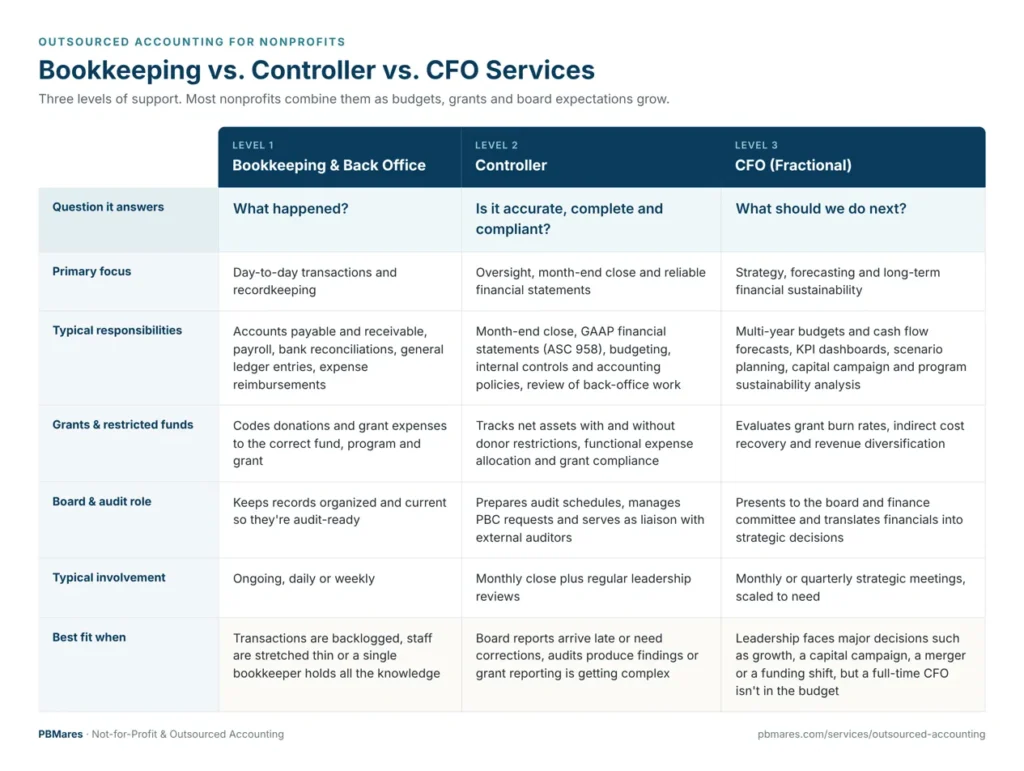
The levels also work alongside an in-house team. A nonprofit might keep its staff accountant for daily entries while an outsourced controller manages the close, or rely on a fractional CFO to guide a board through a multi-year plan. See how one nonprofit foundation outsourced its controller function.
How Outsourced Accounting Supports Audit Preparation
Audit readiness is proactive, and it depends on financial management, clear documentation, and defined oversight. Outsourced accounting teams support that work in several key areas.
Reduces the Risk of Audit Findings
Audits can be stressful, and that’s likely because most audit findings begin with avoidable issues. Simple mistakes can snowball into a major accounting issue. Reconciliations may be completed but not reviewed, or the documentation may be missing altogether. There may be a lack of documented internal controls or errors in federal grant reporting, among many other checkpoints during the audit process. These types of errors can trigger a corrective action plan, increased monitoring, or in the most serious cases, the loss of federal funding.
Outsourced accounting teams work through these areas before the audit begins. They review grant agreements and revenue recognition, reconcile net asset balances to supporting schedules, document control procedures, and confirm reconciliations are completed and reviewed. Problems are addressed during the year rather than during fieldwork.
Maintains Accurate and Reconciled Financial Records
Most audits start with the numbers. Auditors review the trial balance, general ledger, and the reconciliations behind major accounts. When financial records are current, organized, and supported, the audit becomes a more efficient process.
Audit readiness is built through consistent financial management throughout the year. Transactions are recorded accurately and in the proper period. Revenue aligns with grant terms. Expenses are classified correctly. Bank and balance sheet accounts are reconciled on a regular schedule.
Outsourced accounting teams are able to manage this work day-to-day. They record transactions, reconcile accounts, review unusual entries, and maintain documentation as part of routine operations. They often work with internal teams to strengthen month-end close procedures and standardize accounting processes. The nonprofit is prepared for an audit, and leadership has current financial reports that can help drive decision-making.
Strengthens Grant Tracking and Compliance
Grant management is often one of the highest-stakes areas of audit preparation. Auditors look closely at how revenue is recorded, how restricted funds are tracked, and whether costs charged to grants are allowable under the agreement.
Nonprofit accounting teams have a lot of experience in this area, including compliance with the most recent Uniform Guidance. They review grant agreements and make sure everything is recorded properly. They document allowable costs and prepare the SEFA (Schedule of Expenditures of Federal Awards), when required. The major benefit here is that proper grant management reduces the risk of questioned costs and helps protect current and future funding for the nonprofit.
Improves Internal Controls and Financial Procedures
Auditors also assess how the nonprofit manages and oversees its financial activity. Weak internal controls are a frequent source of audit findings. That type of finding can also raise concerns with boards and funders about how financial oversight is handled.
Key internal controls include segregation of duties, access control and multifactor authentication (MFA), approval processes, among others. These are risk management tools. When internal controls are inconsistent or undocumented, errors can go undetected. In more serious situations, weaknesses or lack of controls create opportunities for fraud.
Outsourced accounting helps strengthen these areas. They work to formalize policies and define responsibilities and implement other risk-based strategies. This way controls become part of the routine rather than something addressed only during the audit.
Coordinates Communication and Audit Support
A nonprofit audit is a logistical feat. Auditors ask for schedules, reconciliations, supporting documents, and explanations. Managing those requests in a timely manner can be challenging for staff members who have other duties.
One of the benefits of a dedicated outside provider is that they organize and respond to these requests. This includes managing prepared-by-client (PBC) lists, gathering documentation, and reducing the back-and-forth with the auditor. Questions are answered, and information is provided. In other words, timely coordination reduces delays and frees up staff for other tasks.
What This Means for the Organization
When working with an accounting team on audit preparation, the nonprofit should expect to see:
-
- More efficient audit timelines with organized documentation
- Better cost control by reducing rework and additional testing
- Fewer audit findings through stronger controls and consistent documentation
- Timely, reliable financial statements for board oversight
- On-time grant reporting and regulatory filings
- Less staff time spent responding to audit follow-ups
- Stronger confidence from funders and donors
Choosing the Right Nonprofit Accounting Software
When looking for accounting software, nonprofit leaders often ask what accounting software nonprofit accountants use. But the answer depends on the organization. It’s not one-size-fits-all.
Common accounting software options include:
- QuickBooks Online for nonprofits is a cloud-based system set up for basic accounting needs. It also connects with a wide range of third-party tools for bill pay, payroll, and expense tracking.
- Sage Intacct for nonprofits is more robust and generally a stronger fit for more complex nonprofits. It offers deeper visibility across funds, grants, programs, locations, or entities, along with stronger reporting, automation, and more room to scale.
What to Look for in Nonprofit Accounting Software
From there, nonprofit leaders will want to evaluate software against the same core criteria.
- Support for Daily Operations — Many nonprofits know the frustration of moving between spreadsheets, donor platforms, bill pay tools, payroll systems, and accounting software just to complete routine tasks. A recent survey found that 61%of nonprofit professionals rely on spreadsheets rather than automated solutions, and many also reported limited sharing of financial data between departments, even with accounting software available. A platform should reduce that friction and make operations more efficient. Look for a system that tracks funds, grants, expenses, and reporting requirements consistently, integrates with the existing tech stack, and reduces the manual entry for staff.
- Reporting and Visibility — Leadership needs timely financial information to monitor budgets, track restricted funds, and respond to problems before they grow. Yet many nonprofits struggle in this area. Another survey found that up to 34%of nonprofit respondents said they lacked real-time visibility into key metrics and performance. A strong platform should produce budget-to-actual reporting by fund or program, grant reports that match funder requirements, dashboards, and financial summaries that show where attention is needed. The goal is information leadership can act on, not just more data.
- Data Protection — Nonprofits are increasingly frequent targets for cybersecurity threats, and donors consistently rank the protection of personal information as highly important. A platform should include encryption, regular backups, role-based access, audit trails, and vendor-managed security updates, and nonprofits should have traditional internal controls in place as well. All of these features reduce the risk of a data breach or unauthorized activity and need to be evaluated carefully before committing to any system.
- Scalability — Software choices affect more than current operations. They also determine whether a nonprofit can handle added programs, more grants, staffing changes, or new reporting demands in the future. The goal is not just a system that works today, but one that continues to support the organization as it grows.
Unlocking More Value from the Software
Knowing what to look for is one thing. Getting the full value from the system is another. Even when a nonprofit chooses a strong platform, the software may still fall short if it is not fully set up, connected to existing tools, or built for the reporting leadership needs.
An experienced nonprofit outsourced accounting team can help close that gap. Support may include software selection, implementation, and stronger reporting once the system is in place. It can also help preserve consistency during staff transitions and reduce the loss of institutional knowledge. The software choice matters, but the long-term benefit depends on the setup and ongoing support.
Questions to Ask
To determine if new accounting software is worth pursuing, nonprofit leaders will want to ask the following:
- Does the current accounting system still fit the nonprofit’s needs?
- Is staff spending too much time on spreadsheets or manual entries?
- Are leaders getting real-time financial information that supports decision-making?
- Can the current setup support growth or staffing changes with little notice?
- Would outside accounting support help the organization get more value from its current system?
If any of those answers are unclear, it may be worth taking a closer look and talking with advisors.
“The PBMares Team always makes us feel like we’re their #1 priority. They are responsive and proactive in communication and sharing information, attentive and focused in their field work, they are curious and kind to prioritize understanding and to position themselves as our partners in being good stewards of community resources.”
~ United Way of the Virginia Peninsula
“We have a great relationship with PBMares. I am happy to share that we receive excellent customer service, in-person attention during our annual audits, quick responses when questions arise after audit season and are offered helpful recommendations when we may be looking for other services. This professionalism is appreciated. Thank you!”
~ Norfolk State University Foundation
“The expertise and guidance they provide is invaluable. The services they provide to us are of the highest quality and of superior performance. Their team provides support and guidance to us all year and continually keep us informed and educated. They always respond to us quickly. They provide CCEC with thorough, high quality audits helping to ensure compliance, accuracy, and reduce risk for our membership. We very much appreciate the work they do for us. In addition, they are personable and patient.”
~ Carteret-Craven Electric Membership
“PBMares has gone above and beyond to accommodate and instruct us as our Board creates new challenges for us on a regular basis – especially on the accounting front.”
~ Madison House Autism Foundation
“Our business’ non-profit and personal trust finances are complex and often challenging to navigate well. Impossible without PBMares’ assistance, support, knowledge and relationship for the last three years.”
~ Lighthouse Beacon Church Beacon Institute Foundation
Signs It’s Time to Consider Outsourcing
Transitioning from an internal accounting routine to an external model is rarely a sudden impulse. For most tax-exempt organizations, it is the result of subtle operational friction that eventually builds into a major hurdle. Recognizing these warning signs early enables executive leadership and board members to make a proactive, strategic shift rather than a frantic operational reaction during a crisis.
Rapid Growth Outpacing Internal Capacity
When a nonprofit experiences a surge in funding—whether through a major capital campaign, new federal grants, or expanding donor bases—the complexity of its financial management scales exponentially, not linearly. Systems and spreadsheets that worked for a $500,000 budget quickly break under the weight of a $3 million operation. Internal staff who manage simple recordkeeping often lack the technical training needed to build multi-department budgets, track complex cost allocations, or monitor burn rates across multiple funding sources. When revenue growth causes delays, missed vendor payments, or backlogged reconciliations, internal infrastructure has clearly reached its limit.
High Turnover
Many mid-sized nonprofits rely heavily on a single individual, often a long-tenured business manager or sole bookkeeper—who holds all institutional financial knowledge in their head. If that employee leaves, takes extended leave, or retires, the organization’s entire financial apparatus can grind to a sudden halt. Searching, hiring, and onboarding a replacement in a tight talent market takes months and incurs heavy recruitment costs. Relying on an outsourced team eliminates this single-point-of-failure risk, ensuring continuous operational coverage, standardized processes, and institutional continuity regardless of individual staffing changes.
Board Dissatisfaction and Reporting Delays
Board members have a fiduciary responsibility to exercise duty of care, which requires timely and understandable financial disclosures. When financial packages arrive a day before the board meeting, or worse, weeks late with conflicting numbers, trust between leadership and the board deteriorates. Statements that lack functional expense breakdowns, clear budget-to-actual variances, or net asset restrictions leave board members guessing rather than providing strategic governance. If financial committee meetings spend more time questioning report accuracy than planning for long-term sustainability, an upgrade in financial infrastructure is overdue.
Escalating Grant Complexity and Compliance Pressures
Securing government contracts or institutional funding brings rigid reporting mandates. Federal and state awards require strict adherence to Uniform Guidance, precise time-and-effort tracking, and explicit indirect cost rate allocations. Misinterpreting these rules can lead to claw backs, failed audits, or exclusion from future awards. When an organization turns down funding opportunities because staff lack the capacity to maintain compliant tracking, or when an upcoming audit exposes structural gaps in internal controls, outsourcing provides immediate access to specialized grant accounting expertise without the overhead of hiring senior-level compliance officers.
Choosing the Right Outsourced Accounting Firm
Selecting the right outsourced accounting partner requires looking beyond basic bookkeeping fees to evaluate sector-specific competencies, technical architecture, and cultural fit. Because nonprofit financial management carries unique regulatory and reporting demands, partnering with a generalist commercial firm often leads to misaligned processes and compliance gaps. A rigorous evaluation should focus on four core pillars.
Proven Sector Expertise and Fund Accounting Experience
Nonprofit finances operate under distinct accounting standards (FASB ASC 958) that commercial bookkeepers rarely encounter. Your partner must demonstrate deep familiarity with functional expense allocation, revenue recognition for pledges versus contributions, and the strict segregation of net assets with and without donor restrictions. During discussions, assess their depth of knowledge regarding IRS Form 990 preparation, state charitable solicitation registrations, and federal grant compliance under Uniform Guidance. Request specific case studies or references from organizations of similar budget size and mission complexity.
Technology Infrastructure and Systems Integration
A modern accounting provider should elevate your financial tech stack rather than force you into manual workarounds. Evaluate whether the firm builds cloud-based architectures around established tools like QuickBooks Online, Sage Intacct, or specialized grant platforms, and how seamlessly those tools integrate with your existing CRM, donor management software, and payroll systems (such as Salesforce, DonorPerfect, or ADP). Automated workflows for accounts payable, using platforms like Bill.com, and digital expense management streamline approvals while creating clear, traceable audit trails. The goal is real-time visibility without redundant data entry.
Data Security and Internal Control Protocols
Outsourcing financial operations means sharing sensitive employee, donor, and operational data. Ensure any prospective firm adheres to stringent cybersecurity protocols, including SOC 1 and SOC 2 compliance, multi-factor authentication, and encrypted data transmission. Equally important is how the provider structures segregation of duties within their own team. A robust partner establishes built-in internal controls, ensuring the individual entering invoices cannot also approve payments or reconcile bank accounts, which significantly reduces fraud risk.
Clear Service Level Agreements
To avoid unexpected friction, establish explicit expectations around deliverables, timelines, and communication channels upfront. A strong Service Level Agreement (SLA) should clearly define the monthly close timeline (typically within 10 to 15 business days after month-end), turnaround times for vendor payments, and responsibility matrices for tax filings. Clarify your primary point of contact: will you have a dedicated account lead who understands your organization, or will inquiries route through a generic support queue? Ensure the engagement includes regular, scheduled touchpoints, such as monthly financial reviews with leadership and quarterly board presentation support, to transform raw data into actionable strategy.
Contact Us
PBMares provides nonprofit accounting, tax, audit & consulting services. If you are interested in learning more about our nonprofit services, complete the form below and a team member will follow up shortly.